


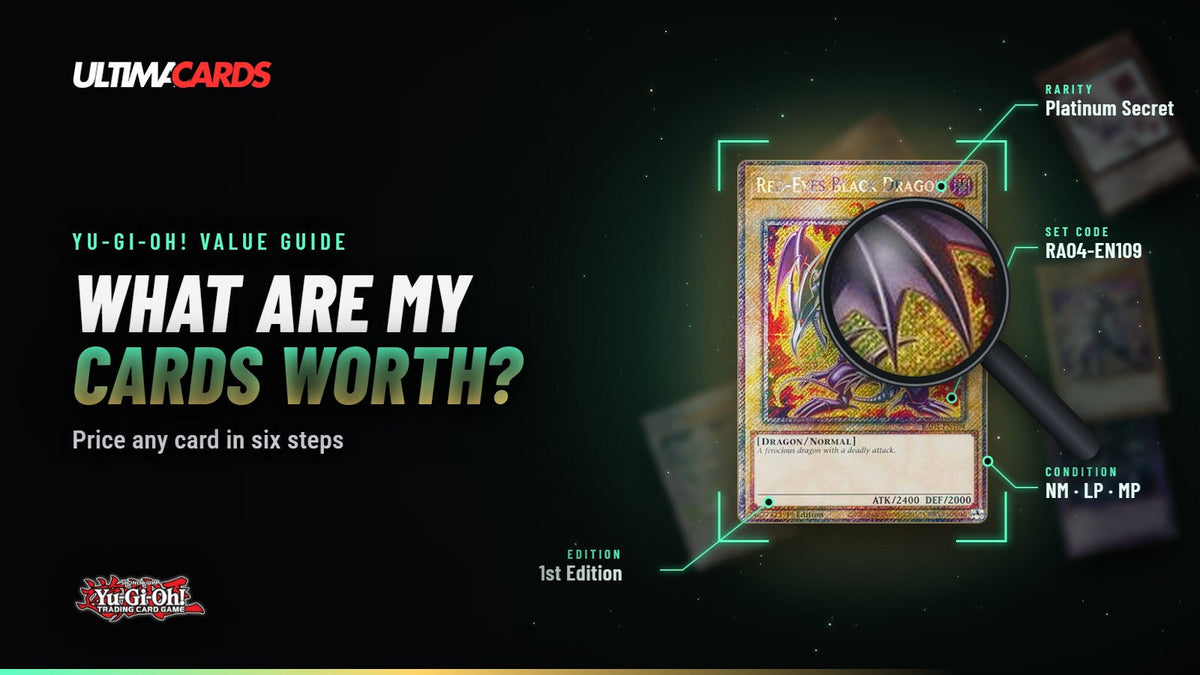
How much are my Yu-Gi-Oh! cards worth? It's the first question anyone asks after finding an old binder, and the honest answer is "it depends on exactly which printing you have." Two cards with the same name can differ in value by a factor of a thousand. This guide gives you a repeatable six-step method to price any card yourself, explains why most cards are worth little and a few are worth a lot, and shows what to expect if you sell.
How much are your cards worth? The six steps
- Identify the exact printing: set code, rarity and edition
- Judge the condition honestly
- Look up sold prices, not asking prices
- Convert to Canadian dollars and compare like with like
- Decide whether it's worth grading
- Know the difference between retail value and what a store will pay
Step 1: Identify the exact printing
The card name is the least useful part. What matters:
Set code. Printed below the artwork on the right, for example LOB-EN001 or RA04-EN109. The letters identify the set, "EN" means English, and the number is the card's position. Very early North American cards like the 2002 Legend of Blue Eyes White Dragon print have no "EN" (LOB-001), which is one way to spot an original.
Edition. Printed below the artwork on the left:
- 1st Edition: the first print run of a set, usually the most valuable
- Limited Edition: promos, tins and special products
- No marking: Unlimited, printed later and in larger numbers
Our 1st Edition vs. Unlimited guide has photos and details.
Rarity. Look at the name and artwork. A plain name with no foil is a Common, and a silver foil name is a Rare. Foil artwork, gold or rainbow names, or a textured surface mean a higher rarity such as Super, Ultra, Secret, Ultimate, Ghost, Starlight, Platinum Secret or Quarter Century Secret Rare. Our rarities guide shows how to tell each one apart.
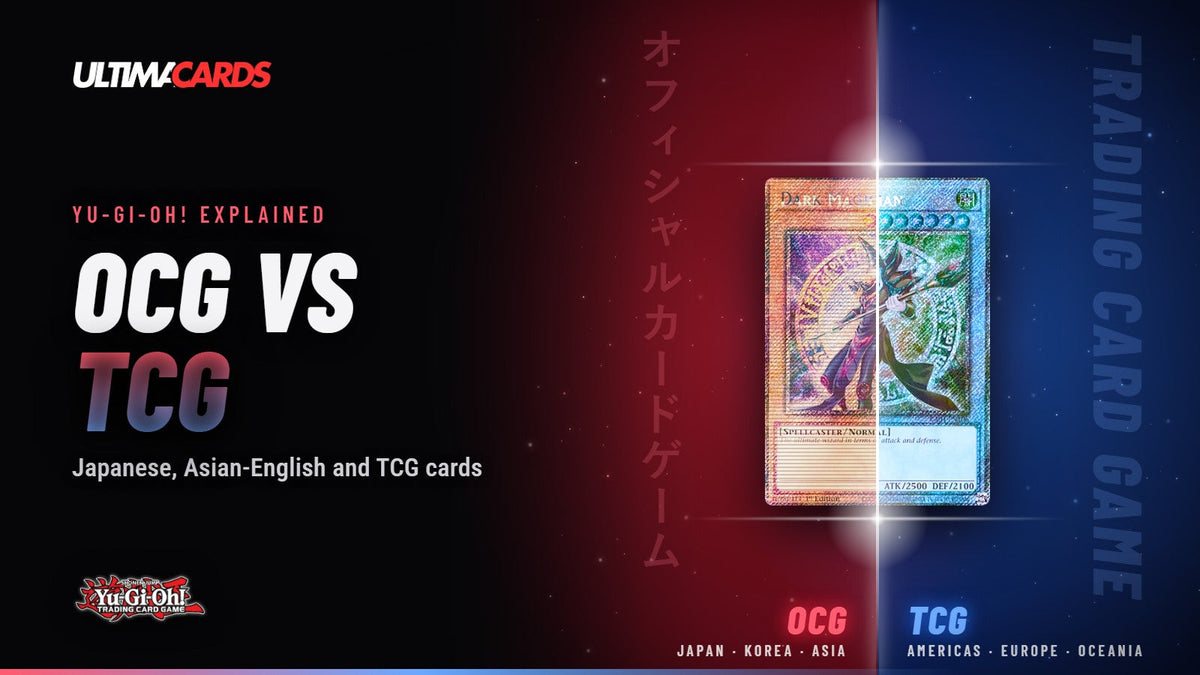
Region and language. English TCG cards, Asian-English cards and Japanese cards are separate markets. See our OCG vs TCG guide.
Step 2: Judge the condition honestly
Condition changes price more than most sellers expect.
| Condition | What it means | Price impact |
|---|---|---|
| Near Mint (NM) | Almost no wear | Full market price |
| Lightly Played (LP) | Minor edge or corner wear | Moderate discount |
| Moderately Played (MP) | Visible wear, light creases or scuffs | Large discount |
| Heavily Played (HP) | Heavy wear, creases | Much lower |
| Damaged (DMG) | Tears, water damage, writing, bends | A fraction of NM |
Inspect the card under bright light: edges (dark Yu-Gi-Oh! backs show whitening clearly), corners, surface scratches on foils, and any bend. Our card condition guide walks through each grade.
Step 3: Look up sold prices, not asking prices
A listing price is what someone hopes to get. A sold price is what someone paid. Always price from sales.
- TCGplayer shows a market price built from recent sales, by printing and condition. It's in US dollars.
- eBay lets you filter for Sold items. Search the set code, not just the name, and look at several recent sales.
- PriceCharting and PSA's auction records are useful for graded cards.
- Cardmarket is the main European marketplace, in euros.
Match all three details from Step 1. A 1st Edition Ultra Rare and an Unlimited Common of the same card are completely different items.
Step 4: Convert to CAD and compare like with like
Most price guides are in US dollars, so convert to Canadian dollars at the current exchange rate. Then sanity-check:
- Are you comparing the same condition? An NM price doesn't apply to an LP card.
- Are the sales recent? Competitive staples can swing hard after a banlist update or a reprint.
- Is the card actually selling? A price with one sale in six months isn't a market.
Step 5: Decide whether to grade
Grading can multiply the value of the right card and waste money on the wrong one. It's usually worth considering for:
- Vintage 1st Edition cards from the early sets in strong condition
- High rarities of popular cards: Ghost, Starlight and Quarter Century Secret Rares
- Cards with personal significance you want sealed and authenticated
It usually isn't worth it for modern Commons, played cards, or anything whose graded value wouldn't cover the fee. Read our Yu-Gi-Oh! grading guide and check centering before you submit anything.
Step 6: Know what a store will actually pay
The market price is what a buyer pays a seller. A store buying your card has to inspect, list, store and resell it, so buylist offers are below market price. That's true at every store. The trade-off is speed and certainty: you get paid without listing, shipping to strangers or dealing with returns.
At Ultima Cards you can check offers on our buylist and choose cash (PayPal or Interac e-Transfer, in CAD) or 40% more as store credit. We take Near Mint and Lightly Played singles. See Sell Your Collection for details, and our guide to selling trading cards in Canada for every option.
What makes a Yu-Gi-Oh! card valuable?
| Factor | High value | Low value |
|---|---|---|
| Age and edition | 1st Edition originals from early sets | Recent Unlimited reprints |
| Rarity | Ghost, Starlight, Quarter Century Secret | Common, Rare |
| Demand | Iconic monsters or current meta staples | Cards no one plays or collects |
| Condition | Near Mint or graded Gem Mint | Played or damaged |
| Supply | Short-printed or never reprinted | Reprinted in every tin |
Reprints matter. When Konami reprints a sought-after card, the price of older non-premium printings often falls. The original 1st Editions and premium rarities usually hold up better.
Cards most people find in old collections
- Commons and bulk: individually worth very little. Sort them out first.
- Original-series icons: Blue-Eyes White Dragon, Dark Magician, Red-Eyes Black Dragon and the Exodia pieces. Value depends entirely on printing and condition. See our Blue-Eyes, Dark Magician and Exodia guides.
- Early-set foils: Ultra Rares and Secret Rares from the first few years, especially 1st Edition.
- Competitive staples: hand traps and generic staples can be worth more than old icons, but their prices move with the meta.
For the very top of the market, see our guide to the most expensive Yu-Gi-Oh! cards.
Before you price a collection: three quick habits
- Sleeve anything that might be valuable before you handle it further.
- Sort by set code, not by name, so identical printings sit together.
- Make a simple spreadsheet with name, set code, rarity, edition, condition and sold price. It makes selling, insuring or grading much easier.
Watch out for fakes too: a "rare" card that feels flimsy or glossy may not be genuine. Our fake card checks take five minutes.
Frequently asked questions
How do I check the value of a Yu-Gi-Oh! card?
Find the set code, rarity and edition, judge the condition, then look up recent sold prices for that exact printing on TCGplayer or eBay's sold listings, and convert to CAD.
Are 1st Edition Yu-Gi-Oh! cards worth more?
Usually, yes, especially for early sets. But a 1st Edition Common from a modern set may still be worth very little. Edition matters most when combined with age, rarity and demand.
Are old Yu-Gi-Oh! cards from 2002 worth money?
Some are. Early-set 1st Edition foils of iconic monsters in good condition can be valuable. Most Commons from the same era aren't.
Why is a store offering less than the price online?
Online market prices are what buyers pay retail. A store's buylist offer accounts for inspection, listing and resale. You trade some value for a fast, certain payout.
Where can I sell Yu-Gi-Oh! cards in Canada?
You can use Ultima Cards' buylist for cash in CAD or 40% more in store credit. See Sell Your Collection.

Leave a comment
This site is protected by hCaptcha and the hCaptcha Privacy Policy and Terms of Service apply.