


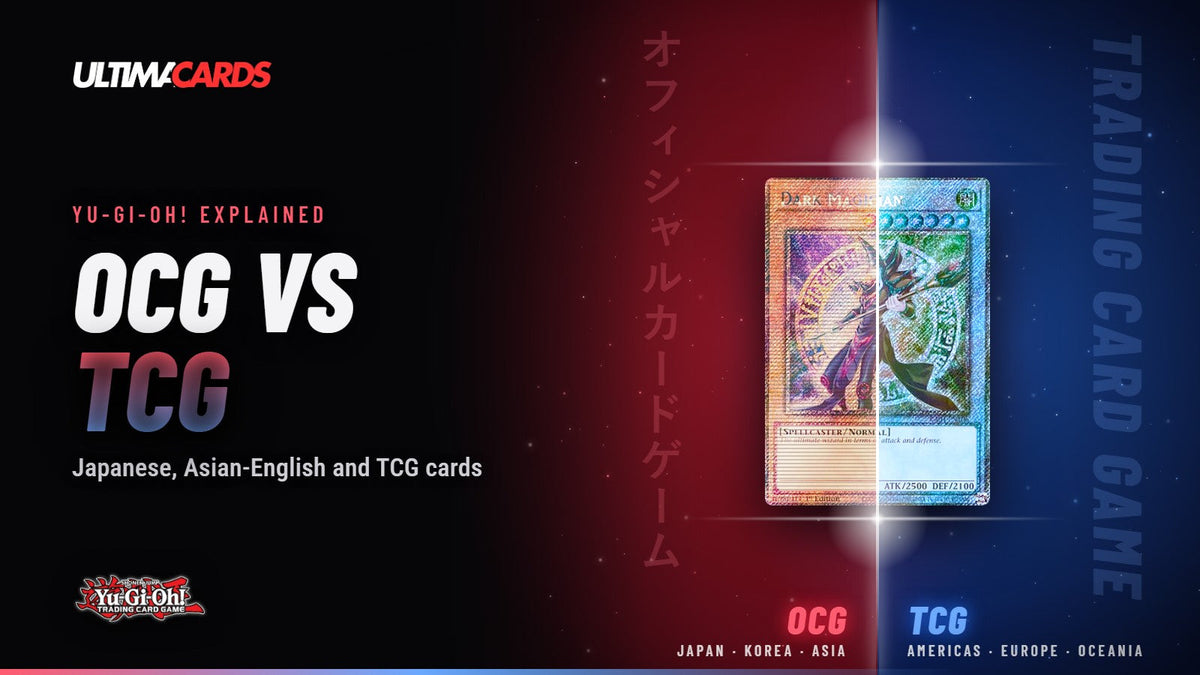
Yu-Gi-Oh! OCG vs TCG comes down to this: Yu-Gi-Oh! is really two games that share one set of rules. The OCG (Official Card Game) is played in Japan and the rest of East and Southeast Asia. The TCG (Trading Card Game) is played in North America, Europe, Oceania and Latin America, including Canada. They have different release schedules, different ban lists, different exclusive cards and rarities, and cards from one aren't legal at the other's events. This guide explains every difference that matters to players and collectors, as of October 2026.
Yu-Gi-Oh! OCG vs TCG at a glance
| OCG | TCG | |
|---|---|---|
| Stands for | Official Card Game | Trading Card Game |
| Launched | February 1999, Japan | March 2002, North America |
| Played in | Japan, South Korea, China, Hong Kong, Taiwan, Southeast Asia | North America, Europe, Oceania, Latin America |
| Languages | Japanese, Korean, Asian-English, Simplified Chinese | English, French, German, Italian, Portuguese, Spanish |
| Ban list | OCG Forbidden & Limited List (Asian-English has its own) | TCG Forbidden & Limited List |
| Legal at Canadian events | No | Yes |
Where each game is played
The OCG started in Japan in February 1999. Today it's played mainly in Japan and South Korea, and also in China, Hong Kong, Taiwan, Indonesia, Malaysia, the Philippines, Singapore and Thailand. Cards are printed in Japanese, Korean, Asian-English and Simplified Chinese.
The TCG launched in North America with Legend of Blue Eyes White Dragon on March 8, 2002. It's the version sold and played in Canada, the US, Europe, Oceania and Latin America.
Card legality: can you play Japanese cards in Canada?
No, not at official TCG events. Konami's card legality rules say cards printed in Japanese, Korean, Chinese or Asian-English (OCG cards) can only be played in Asian territories and aren't legal at Yu-Gi-Oh! TCG events. The reverse is also true: TCG cards aren't legal in OCG tournaments.
For casual games at home, use whatever your playgroup agrees on. OCG and TCG cards are the same size, but the backs differ, so if you mix them you need sleeves with opaque backs.
Different ban lists
Since September 2013, the OCG and TCG have had separate Forbidden & Limited Lists. A card can be Forbidden in one and Unlimited in the other, in either direction. Asian-English has had its own list since November 2023, to handle cards that exist in Asian-English before they're legal in the wider OCG.
If you're reading decklists or tier lists online, check which game they're for. An OCG list may run cards you can't use at your locals. Our Yu-Gi-Oh! banlist guide covers the current TCG list, and the TCG also has the points-based Genesys format.
Release schedules and exclusive cards
The two games don't release the same products at the same time:
- The OCG usually gets cards first. Many cards debut in Japan and reach the TCG later, sometimes in a different set.
- Each game has exclusives. TCG core boosters include "TCG premiere" cards that the OCG doesn't have yet, and the OCG has cards the TCG hasn't printed.
- Products differ. Box contents, pack sizes and special sets are designed separately for each market.
For collectors, this means a card can have a different set code, rarity and release date depending on the region.
Rarities that only exist in the OCG
Both games share the core rarities (Common through Secret Rare, plus Ultimate and Quarter Century Secret Rare), but some treatments are regional:
| OCG rarity | What it is |
|---|---|
| Holographic Rare | The OCG version of the TCG's Ghost Rare: a monochrome holographic image |
| Extra Secret Rare | Secret Rare foil across almost the whole card surface |
| 20th Secret Rare | Red holographic name and an OCG 20th Anniversary watermark |
The TCG has its own exclusive treatments too, including several of its Starfoil, Mosaic and Shatterfoil variants. Our rarities guide covers the TCG side in detail.
Japanese vs. Asian-English vs. TCG English cards
| Japanese | Asian-English | TCG English | |
|---|---|---|---|
| Game | OCG | OCG | TCG |
| Text | Japanese | English, TCG names and wording | English |
| Artwork | Original Japanese art | Original Japanese art on new sets (since 2023) | Some artwork edited for the TCG |
| Card back | Japanese logo | Japanese logo with "Trading Card Game" text | TCG logo |
| Legal in Canada | No | No | Yes |
Asian-English cards are the confusing ones: they're printed in English with TCG card names, but they're part of the OCG. You can identify them by the "AE" in the set code and the Japanese-style card back. Asian-English printing paused after 2009 and came back in late 2023 with Japanese card backs and the original, unedited artwork.
Artwork edits. For decades, some TCG artwork was edited to remove content such as weapons, blood or revealing outfits. Collectors who prefer the original art often buy Japanese or newer Asian-English printings for their binders.
Which version should you buy?
- You play at locals or events in Canada: buy TCG English cards. Nothing else is legal. Browse Yu-Gi-Oh! singles.
- You collect for art or rarity: Japanese cards are worth a look for original artwork and OCG-only rarities. Price them separately from TCG versions, because they're a different market. See how to price Yu-Gi-Oh! cards.
- You're grading: major graders such as PSA accept Japanese cards, and the label states the language. Our grading guide explains the process.
Yu-Gi-Oh! cards in both games use the same small size, so Japanese-size sleeves fit either.
Watch out for fakes posing as "Asian" cards
Some counterfeits are sold as "Asian" or "Japanese" versions to explain away odd text or colours. A genuine Asian-English card has the AE set code, clean printing and the correct card back. Read our guide to spotting fake Yu-Gi-Oh! cards before buying cheap "Asian" foils.
Frequently asked questions
What is the difference between OCG and TCG?
The OCG is the Asian version of Yu-Gi-Oh! and the TCG is the version played in North America, Europe, Oceania and Latin America. They share rules but have separate ban lists, release schedules, exclusive cards and rarities, and their cards aren't legal in each other's tournaments.
Are Japanese Yu-Gi-Oh! cards legal in Canada?
Not at official TCG events. Japanese, Korean, Chinese and Asian-English cards are OCG cards and are only tournament-legal in Asian territories.
Are Asian-English cards fake?
No. Asian-English cards are genuine OCG cards printed in English for Asia. They have "AE" in the set code and a Japanese-style card back. They just aren't legal at TCG events.
Why does the OCG get cards before the TCG?
Yu-Gi-Oh! started in Japan, and most cards still debut in the OCG before being adapted and scheduled for the TCG. The TCG also gets some cards first as TCG premieres.
Do OCG and TCG cards use the same sleeves?
Yes. Both use the same small card size, so Japanese-size sleeves fit both. Use opaque-backed sleeves if you mix OCG and TCG cards in casual play.

Leave a comment
This site is protected by hCaptcha and the hCaptcha Privacy Policy and Terms of Service apply.