


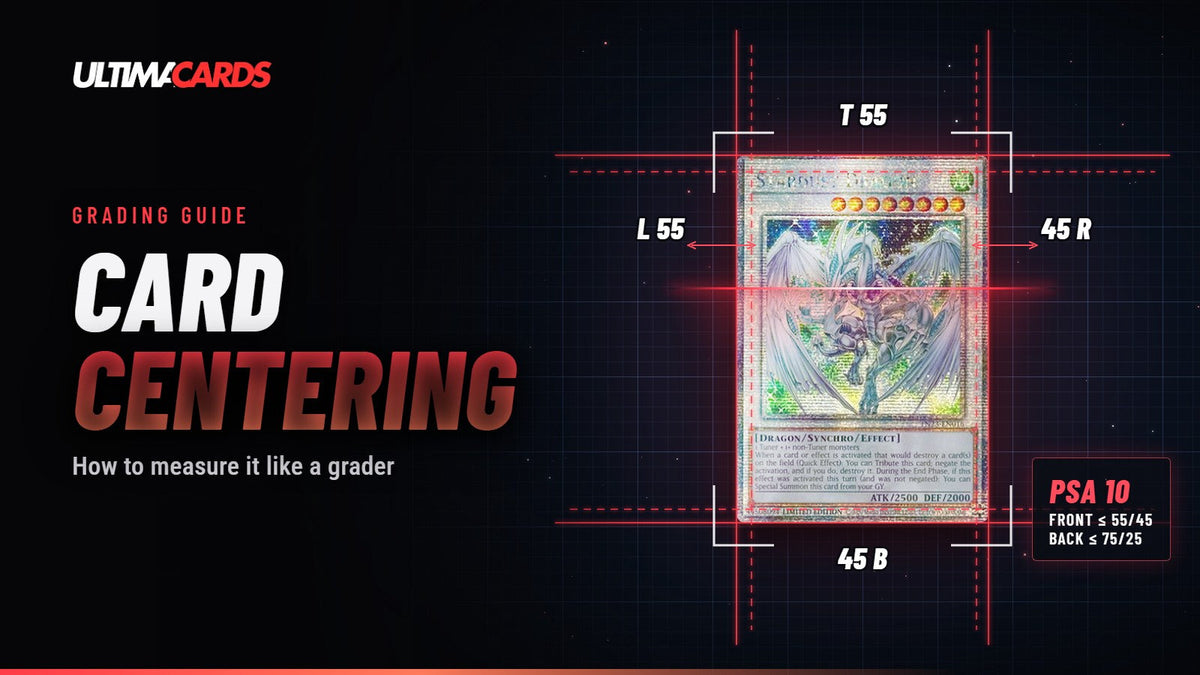
Card centering is the one part of a card's grade you can't improve by being careful. It's set at the factory when the card is cut, and it decides whether a perfect-looking card can get a 10 at all. This guide explains what centering ratios like 55/45 mean, how to measure them accurately at home, the published PSA and CGC tolerances for each top grade, and how to use centering to decide which cards are worth sending in. Standards were checked against each grader's website in October 2026.
What card centering means
Every card has a printed design and a cut edge. Centering is how evenly the design sits between the edges, measured on two axes:
- Left to right: the left border compared with the right border
- Top to bottom: the top border compared with the bottom border
Graders check both axes on the front and on the back, and the back is allowed to be less even than the front.
What 55/45 actually means
A ratio like 55/45 describes how the total border on one axis is split between the two sides. To calculate it:
Wider border ÷ (left border + right border) × 100
| Left border | Right border | Calculation | Centering |
|---|---|---|---|
| 2.0 mm | 2.0 mm | 2.0 ÷ 4.0 | 50/50 (perfect) |
| 2.2 mm | 1.8 mm | 2.2 ÷ 4.0 | 55/45 |
| 2.4 mm | 1.6 mm | 2.4 ÷ 4.0 | 60/40 |
| 2.6 mm | 1.4 mm | 2.6 ÷ 4.0 | 65/35 |
| 2.8 mm | 1.2 mm | 2.8 ÷ 4.0 | 70/30 |
Notice how small the differences are. On a border a couple of millimetres wide, the gap between a 10-eligible 55/45 and a 60/40 is about 0.2 mm per side. That's why eyeballing it rarely works.
PSA centering standards
These are PSA's published limits for the front and back of a card, which the card must meet as well as the other criteria for each grade:
| PSA grade | Front | Back |
|---|---|---|
| PSA 10 Gem Mint | 55/45 or better | 75/25 or better |
| PSA 9 Mint | 60/40 or better | 90/10 or better |
| PSA 8 NM-MT | 65/35 or better | 90/10 or better |
| PSA 7 NM | 70/30 or better | 90/10 or better |
PSA says its graders may occasionally allow a little leeway on centering when a card's overall eye appeal is strong. That cuts both ways: a card that technically measures within a grade can be held back if it looks off-centre, especially on designs with high-contrast borders. A card that's otherwise strong but badly off-centre may receive an OC (off-center) qualifier.
CGC centering standards
| CGC grade | Front | Back |
|---|---|---|
| Pristine 10 | 50/50 | Not separately stated |
| Gem Mint 10 | 55/45 or better | 75/25 or better |
| Mint 9 | 60/40 or better | 90/10 or better |
| NM/Mint 8 | 65/35 or better | Not separately stated |
CGC's Pristine 10 sits above Gem Mint 10 and requires essentially perfect centering. Other graders, including Beckett and TAG, publish their own scales, and TAG uses imaging technology with a detailed report for each card. Check the current scale on each grader's site before you submit.
How to measure centering at home
1. Pick the right reference line
Measure from the cut edge of the card to the first printed line that runs parallel to it, and use the same reference on both sides.
- Yu-Gi-Oh! fronts: the coloured frame runs right to the edge, so for left and right, measure from each edge to the artwork box. Top and bottom aren't symmetrical by design, so compare against a well-centred copy of the same card. Backs: measure the dark brown border around the swirl design, which is easy to see.
- Riftbound and other standard-size cards: measure the printed border on each side.
- Full-art and borderless cards are harder. Graders judge the overall position of the print, so compare with other copies of the same card.
2. Get a straight, sharp image
A ruler is too coarse for borders this thin. Instead:
- Scan the card flat at 600 dpi or higher, or
- Photograph it straight on, with the camera parallel to the card and the card filling the frame, in even light.
3. Measure in pixels
Open the image in any photo editor and measure each border in pixels. Pixels work as well as millimetres, because you only need the ratio. Do the left/right and top/bottom axes on both the front and the back. Centering apps and online calculators do the same thing automatically.
4. Use the worst axis
Your card's centering for grading purposes is its worst ratio. A card that's 50/50 left to right but 62/38 top to bottom is a 62/38 card.
Using centering to decide what to grade
Centering is the fastest pre-screen there is:
- Measure first. If the front is worse than 55/45, a PSA or CGC Gem Mint 10 isn't realistic, however clean the card looks.
- Then check everything else. Corners, edges and surface still have to be near-perfect. See our Yu-Gi-Oh! condition guide.
- Do the maths. If the card's value at the grade it can realistically get doesn't cover the grading fee and shipping, keep it raw.
- Compare copies. If you're buying a card specifically to grade, buy the best-centred copy you can see in person, or ask the seller for scans.
Game-specific grading guides: Yu-Gi-Oh! and Riftbound.
Can centering be fixed?
No. Centering comes from how the sheet was cut. Any attempt to "fix" it by trimming the edges is tampering: PSA won't grade cards with evidence of trimming, and a trimmed card loses most of its value. If you see a raw card with suspiciously perfect centering and slightly narrow dimensions, be cautious.
Protecting a well-centred card
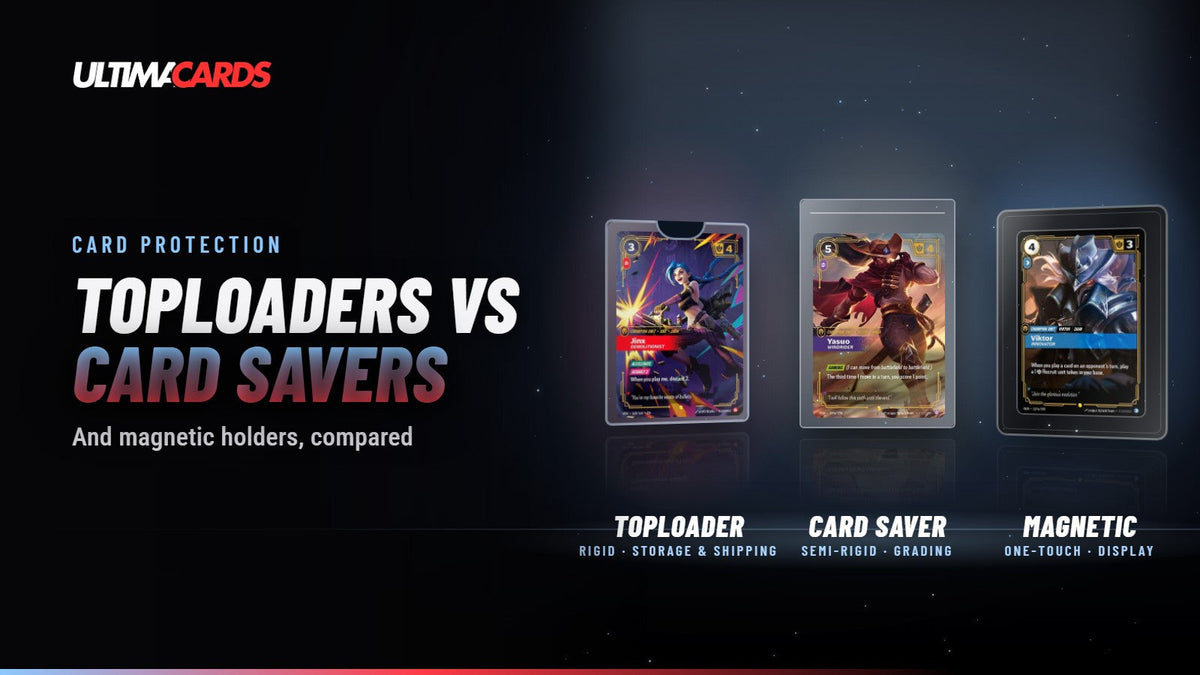
Once you've found a card worth grading, keep it that way: penny sleeve, then a semi-rigid holder for submission or a toploader for storage. Our guide to toploaders, card savers and magnetic holders explains which to use when, and graded slabs can go in a GradedGuard case.
Frequently asked questions
What centering do you need for a PSA 10?
PSA's standard for Gem Mint 10 is 55/45 or better on the front and 75/25 or better on the back, with the grader allowed a small variance based on eye appeal.
How do you calculate card centering?
Measure the two opposite borders, divide the wider one by their total, and multiply by 100. For example, 2.2 mm and 1.8 mm give 2.2 ÷ 4.0 = 55%, so 55/45.
Is back centering as important as front centering?
It counts, but the limits are looser. PSA allows 75/25 on the back for a 10 and 90/10 for grades 7 to 9.
Can an off-centre card still get a high grade?
Yes, within each grade's limits. A card at 60/40 on the front can still be a PSA 9 if everything else is excellent. Badly off-centre cards may get an OC qualifier.
What's the difference between CGC Pristine 10 and Gem Mint 10?
Pristine 10 requires 50/50 centering and an essentially perfect card. Gem Mint 10 allows up to 55/45 on the front and 75/25 on the back.

Leave a comment
This site is protected by hCaptcha and the hCaptcha Privacy Policy and Terms of Service apply.