


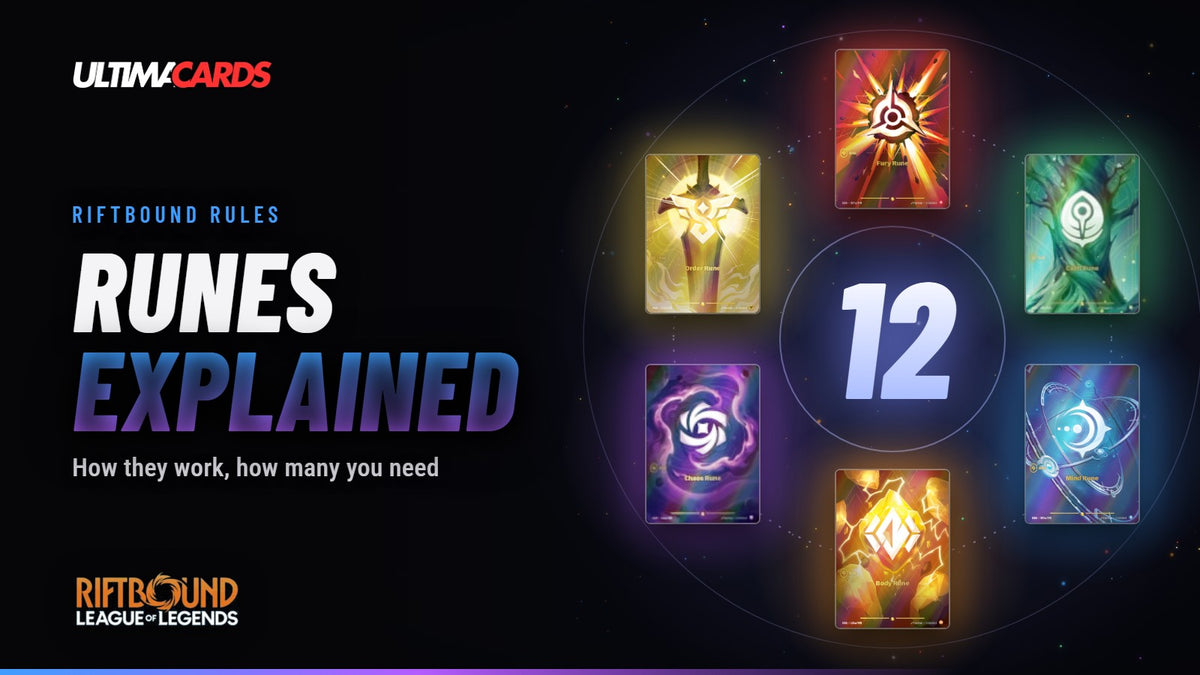
Riftbound runes are the game's resource system, and they work differently from lands or energy in other card games. You never draw them, you can't miss one, and every rune can pay for a card in two ways. They're also the cards you'll use in every game you play, which makes them worth a few minutes to understand and a small amount of money to get right. This guide covers the rules, the deck building decisions and the buying questions.
Card text below comes from Riot's official Riftbound card gallery, checked November 14, 2026.
How Riftbound runes work

Every deck has a rune deck of exactly 12 runes. It sits in its own zone and is never shuffled into your main deck. Each turn has a Channel Phase, where you put the top 2 runes of that deck into play. In a 1v1 game, the player going second channels an extra rune on their first turn.
A rune in play can pay for cards in two ways:
- Exhaust it to make 1 energy. Energy is the numbered cost on a card. The rune readies again at the start of your next turn.
- Recycle it to make 1 power of that rune's domain. Power is the domain symbol in a card's cost. Recycling puts the rune on the bottom of your rune deck, so it leaves the board.
That's the tension in the system. Energy is free to reuse. Power costs you a rune on the board until you channel it again. A hand full of power-hungry cards will leave you with fewer runes than your opponent. Our how to play Riftbound guide walks through a full turn.
The six runes
There's one basic rune for each domain: Fury, Calm, Mind, Body, Chaos and Order. Your rune deck can only contain runes from your Legend's two domains. A Kai'Sa deck is Fury and Mind, so its 12 runes are some mix of Fury Runes and Mind Runes.
Any rune makes energy. Only a rune of the matching domain makes that domain's power. So the split between your two domains only matters for power costs. Our Riftbound domains guide covers what each domain does.
How to split your 12 runes
Start by counting the power symbols in your main deck, by domain.
| Your power costs | Starting split |
|---|---|
| About even between both domains | 6 and 6 |
| Leaning toward one domain | 7 and 5 |
| Mostly one domain, with a light second | 8 and 4 |
Then adjust for timing. If an important early card needs a specific domain's power, favour that domain so the right rune is in play when you need it. An even split is a fine first draft. Play ten games, note which cards sat in your hand because you had the wrong runes, and move one rune at a time. Our Riftbound deck building guide covers the rest of the 40-card list.
Remember that your rune deck's order matters after the first pass. Recycled runes go to the bottom, so the runes you recycle early are the ones you'll channel again late.
Cards that bend the rune rules
Some cards get you ahead on runes or make power without the usual cost. These are worth knowing when you build.
Extra channeling
- Catalyst of Aeons (Origins, Uncommon spell, Body): channel 2 runes exhausted. If you can't, draw 1.
- Volibear, Relentless Storm (Origins Legend): when you play a Mighty unit, you may exhaust him to channel 1 rune exhausted.
- Fiora, Grand Duelist (Spiritforged Legend): when one of your units becomes Mighty, you may exhaust her to channel 1 rune exhausted.
- Startipped Peak (Origins battlefield): when you hold here, you may channel 1 rune exhausted.
- The Papertree (Spiritforged battlefield): when you hold here, each player channels 1 rune exhausted.
Runes channeled this way arrive exhausted, so they don't give you energy that turn. They can still be recycled for power, and they're ready the turn after.
Power without recycling
The six Seals are Epic gear from Origins that cost 0 energy: Seal of Rage (Fury), Seal of Focus (Calm), Seal of Insight (Mind), Seal of Strength (Body), Seal of Discord (Chaos) and Seal of Unity (Order). Each exhausts to add one power of its domain. A Seal in play means one power per turn that doesn't cost you a rune. In a deck with heavy power costs, that's a real advantage over a long game.
Several Legends do something similar with limits. Kai'Sa, Daughter of the Void adds one power of any domain that can only be spent on spells. Ornn, Fire Below the Mountain does the same for gear.
One caution: Obelisk of Power, an Origins battlefield that gave each player an extra rune on their first turn, is on the ban list. Check the current Riftbound ban list before you register battlefields.
How many runes do you need to buy?
You need 12 for a deck. To build any deck in a given domain without thinking about it, own 8 or 9 of each domain you play, since the heaviest common split is 8 and 4. To cover every domain, that's around 50 runes. To cover one two-domain deck, it's 12 to 16.
Runes are easy to get. Every booster pack has one slot for a rune or token, and every preconstructed deck comes with its 12. If you've opened any amount of sealed product, you probably have basics already. If you're building from singles, base runes are Commons and among the cheapest cards in the game.
Alternate art runes

Runes are also the most visible place to dress up a deck, because they're on the table in every game.
- Origins has six alternate art runes, numbered inside the set: 007a (Fury), 042a (Calm), 089a (Mind), 126a (Body), 166a (Chaos) and 214a (Order).
- Later sets number runes separately as R01 to R06, in the order Fury, Calm, Mind, Body, Chaos, Order. Their alternate art versions are R01a to R06a.
Alternate art runes are foil and play exactly like base runes. You can mix printings freely in one rune deck. Many players build toward a matching 12 for their main deck and leave the rest as basics. Our Riftbound alternate art guide explains the numbering in more detail.
A practical note on foils: foil cards can curl slightly, and a rune deck is kept face-down. If only some of your runes are foil and they sit differently in the pile, the difference can be visible. Sleeve the whole rune deck in the same opaque sleeves, and if you mix foil and non-foil runes, check that they look identical from the back. Our Riftbound sleeves guide covers sizes.
Buying Riftbound runes
Search "rune" in our Riftbound singles to see base and alternate art runes together, or browse Origins singles for the first set's printings. The listing title shows the domain, whether it's alternate art, and the collector number. Every card we sell is 100% authentic, we ship across Canada, and Canadian orders over $250 CAD ship free.
Frequently asked questions
How many runes are in a Riftbound deck?
Exactly 12, in a separate rune deck. They must come from your Legend's two domains.
How many runes do you get each turn?
You channel 2 runes in each Channel Phase. In 1v1, the player going second channels one extra on their first turn.
What's the difference between energy and power?
Energy is the numbered cost, paid by exhausting runes. Power is the domain-symbol cost, paid by recycling a rune of that domain to the bottom of your rune deck.
Can you run out of runes?
You can run out of runes to channel once all 12 are in play, but recycled runes return to the bottom of the rune deck and get channeled again.
Do alternate art runes do anything different?
No. They're the same card with different artwork, and you can mix them with base runes.

Leave a comment
This site is protected by hCaptcha and the hCaptcha Privacy Policy and Terms of Service apply.