


A Riftbound budget deck isn't a weak deck. It's a deck where you've been deliberate about which cards get the money. Most of a Riftbound list is made of Commons and Uncommons, and the game gives you your most important card every game for free. That means a careful buyer can get close to a full-price list for a fraction of it. This guide shows where the cost in a deck sits and the order to buy in.
We haven't quoted prices here, because singles prices move every week. Card text and rarities come from Riot's official Riftbound card gallery, checked November 14, 2026.
What a Riftbound deck needs

Here's the full shopping list, with the rarity each part usually is:
| Part | Count | Typical rarity |
|---|---|---|
| Legend | 1 | Rare |
| Chosen Champion | 1 | Rare or Epic |
| Rest of the main deck | 39 | Mostly Common and Uncommon |
| Runes | 12 | Common |
| Battlefields | 3 | Uncommon |
That's 56 cards. Only a handful need to be anything above Uncommon. Our Riftbound deck building guide has the full construction rules.
Where the cost of a deck sits
Four things make a Riftbound list expensive. Three of them are optional.
- Epics you play three of. An Epic you need as a 3-of is the biggest real cost in most lists. This is the one that affects how the deck plays.
- Showcase printings. Alternate art, overnumbered and Signature cards play exactly like the base version. They're optional.
- Foils. A foil and a regular copy of the same card are the same card in a game. Optional.
- Whatever won last weekend. Cards from the deck that just did well at a big event cost more for a few weeks. Waiting is optional too, but it works.
So the method is simple: buy base, non-foil copies, spend on the few Epics that matter, and build around cards whose demand isn't spiking.
Step 1: Pick a Legend with a cheap core
Every Legend is a Rare in its base printing, so the Legend itself is rarely the expensive part. What matters is what the Legend asks you to buy.
- Look for a Rare champion unit. In Origins, each of the twelve champions has two units, one Rare and one Epic. Either can be your Chosen Champion. If the Rare one fits your plan, you've saved your first Epic.
- Count the two-domain Epics. Cards that need both of your domains are often the strongest in a Legend's package, and you can run at most 3 signature cards. Find out which ones your Legend wants before you commit.
- Prefer older Legends. Origins and Spiritforged have been opened for longer than any other sets, so their Commons, Uncommons and Rares are the most available. Our Riftbound Origins guide and Riftbound Spiritforged guide list every Legend in each.
Don't pick a Legend only because it's cheap. Pick from the ones you'd enjoy, then choose the cheapest of those. Our Riftbound Legends list covers all of them.
Step 2: Build the unit base from Commons and Uncommons

Riftbound is won at battlefields, and you contest battlefields with units. A typical midrange list runs 20 to 24 units, and most of those slots don't need to be Rare.
Some examples of low-rarity cards that do real work:
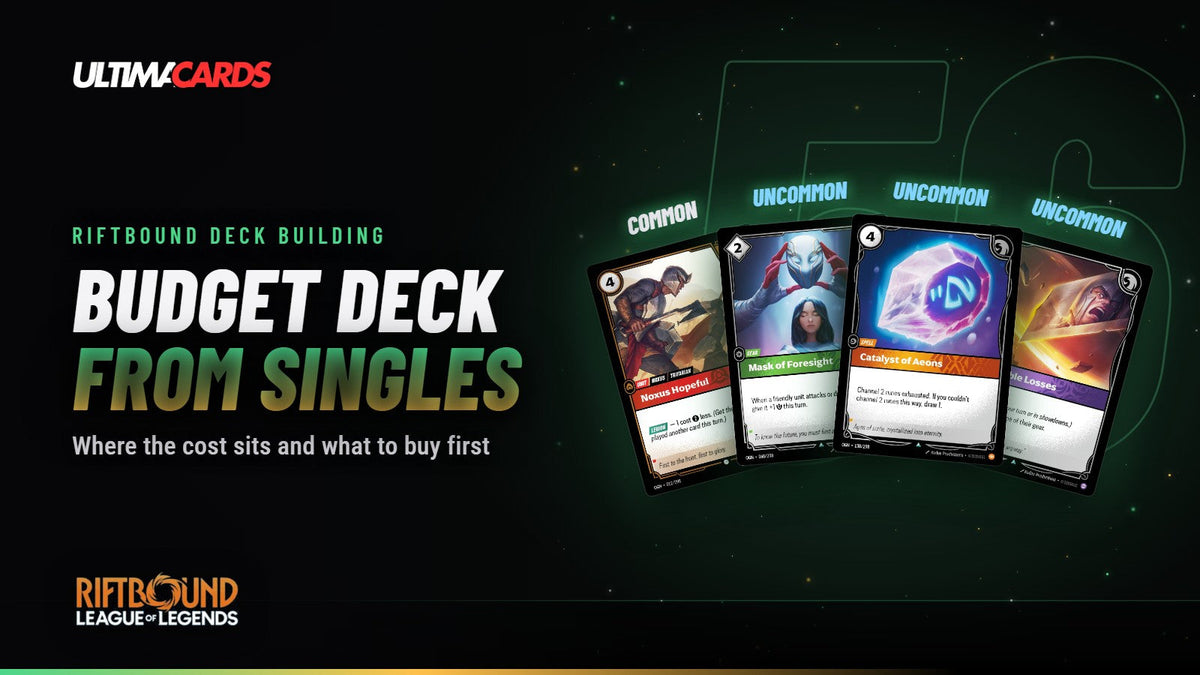
- Noxus Hopeful (Common, Fury): a 4-energy unit that costs 2 less with Legion, which you get by playing another card that turn.
- Mask of Foresight (Uncommon gear, Calm): gives +1 Might to a friendly unit that attacks or defends alone.
- Catalyst of Aeons (Uncommon spell, Body): channels 2 extra runes, or draws a card if it can't.
- Acceptable Losses (Uncommon spell, Chaos): a 1-energy answer to an opponent's gear.
The general rule: at low rarity, look for cards that are efficient at one job. Epics tend to be flexible or to win the game on their own. Commons tend to be good at one thing. A deck of cards that each do one thing well, on a sensible curve, beats a pile of powerful cards that don't fit together.
Step 3: Get runes and battlefields almost for free
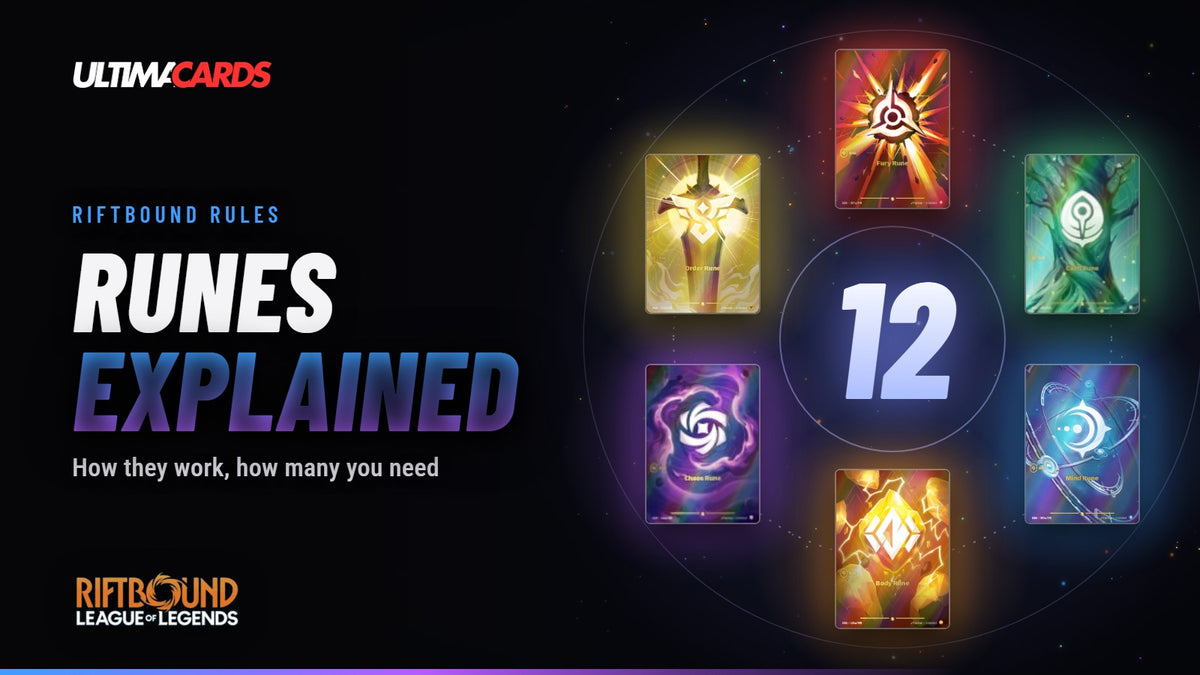
Your 12 runes are Commons. Base runes are among the cheapest cards in the game, and every booster pack and preconstructed deck includes them. Our Riftbound runes guide explains how to split them.
Almost every battlefield printed so far is an Uncommon, which is unusual for cards that matter this much. Three well-chosen battlefields can improve a deck more than three Epics, for much less. Just check the Riftbound ban list first: several of the strongest early battlefields are banned, and a banned battlefield is wasted money for tournament play. Our Riftbound battlefields guide explains how to pick them.
Step 4: Spend on the few Epics that matter
Now add the expensive cards, in this order:
- Epics your Legend's plan depends on. If the deck doesn't function without a card, buy it.
- One or two copies before three. Running 2 of an Epic instead of 3 costs you a little consistency, not the whole plan. Add the third later.
- A Seal, if your power costs are heavy. The six Seals are Epic gear that make one power a turn without recycling a rune. They're useful in many decks that share a domain, so they hold their usefulness when you switch Legends.
Skip Epics that are only "good". On a budget, an Epic has to be necessary.
Step 5: Upgrade in the right order
Once the deck works, upgrade based on what your games tell you:
- Fix what loses you games. Track the cards that sat unplayed in your hand and the matchups you lost. Replace the first, add answers for the second.
- Fill out the 3-ofs. Take your 2-of Epics to three.
- Add a sideboard. Up to 8 cards for best-of-three matches. Narrow answers are often cheap.
- Then cosmetics. Alternate art for your Chosen Champion or runes comes last. Our Riftbound alternate art guide covers those.
Starting from a preconstructed deck
If you own a Proving Grounds deck or a Champion Deck, you already have a Legend, a champion, runes and a list you can play. That's a budget deck with the cheap parts done. Keep the Legend and runes, and replace the weakest main deck cards a few at a time with singles. Our Riftbound starter deck guide compares the preconstructed options.
Opening booster packs is the one approach that doesn't work on a budget. A pack is 14 random cards from six domains, and your deck uses two. Our Riftbound singles vs. booster boxes post explains the numbers.
Buying singles for a Riftbound budget deck
On our Riftbound singles page, sort by price from low to high and filter by rarity to find the Commons and Uncommons for your list. Listings without "Foil" in the title are the regular printings. Buying the whole list in one order usually makes more sense than several small ones, because shipping is charged per order, and Canadian orders over $250 CAD ship free. Every card we sell is 100% authentic.
Frequently asked questions
What is the cheapest way to build a Riftbound deck?
Buy singles in base, non-foil printings. Build the unit base from Commons and Uncommons, and spend only on the Epics your Legend's plan needs.
Can a budget Riftbound deck win at a store event?
Yes. A consistent, well-built list will win games at a weekly Nexus Night. The gap to a full-price list is usually a handful of Epics, not the whole deck.
Are foil cards better than non-foil?
No. They're identical in play. Foils cost more and can curl, so non-foil is the practical choice for a deck.
Should I upgrade a starter deck or build from scratch?
If you already own one, upgrade it. You have the Legend, runes and a playable list already. If you don't, building from singles lets you choose the Legend you want.
How many Epics does a Riftbound deck need?
There's no rule. Many lists run a few Epics as 2-ofs or 3-ofs and fill the rest with lower rarities. Start with the ones your plan can't work without.

Leave a comment
This site is protected by hCaptcha and the hCaptcha Privacy Policy and Terms of Service apply.