


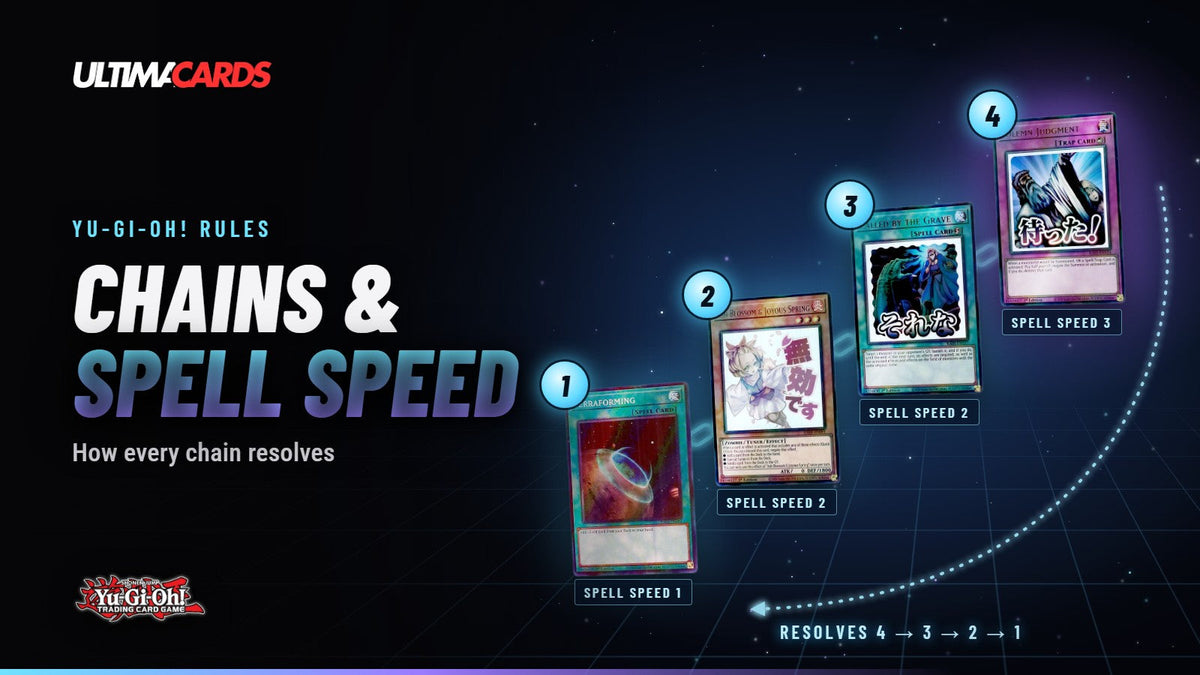
Yu-Gi-Oh! chain rules decide what happens when players activate cards in response to each other, and they're behind most rules arguments at a locals table. The core idea is simple: cards stack up in a chain, and the chain resolves backwards. The details (spell speeds, simultaneous triggers, "when" vs. "if") are where games are won and lost. This guide explains each rule in plain English and walks through a real four-link chain you'll see in competitive play.
What is a chain?
A chain forms whenever a card or effect is activated. Each activation is a Chain Link: the first is Chain Link 1 (CL1), the response to it is CL2, and so on.
After any activation, the opponent of the player who activated gets the first chance to respond. If they respond, the other player can respond to that, and so on, until both players pass. Then the chain resolves in reverse order: the last card activated resolves first.
That's the most important rule in this guide: last in, first out. The final response always gets to happen before the thing it's responding to.
Spell speed: what can respond to what
Every activated card or effect has a spell speed from 1 to 3. You can only respond to a Chain Link with something of equal or higher spell speed, with one exception: Spell Speed 1 can never respond at all.
| Spell speed | What has it | Can it respond to a chain? |
|---|---|---|
| 1 | Normal, Equip, Field, Ritual and Continuous Spells; Ignition, Trigger and Flip monster effects | No. It can only start a chain as Chain Link 1 |
| 2 | Quick-Play Spells, Normal and Continuous Traps, Quick Effects (including hand traps) | Yes, to Spell Speed 1 or 2 |
| 3 | Counter Traps | Yes, to anything. Only another Spell Speed 3 can respond to it |
Some practical consequences:
- Normal Spells can't be chained. You can't respond to your opponent's monster effect with Pot of Prosperity or Terraforming.
- Hand traps are Spell Speed 2. Ash Blossom & Joyous Spring, Infinite Impermanence and friends can respond to Spell Speed 1 and 2. See our hand traps guide.
- Counter Traps are the last word. Once a Counter Trap is on the chain, only another Counter Trap can respond.
- Set Traps and Set Quick-Play Spells usually can't be activated the turn they're Set. Quick-Play Spells can be activated from the hand during your own turn.
A worked example: Terraforming, Ash Blossom, Called by the Grave, Solemn Judgment
Here's a chain you'll see at any competitive event. Player A is the turn player.
- CL1, Player A: activates Terraforming (Normal Spell, Spell Speed 1): "Add 1 Field Spell from your Deck to your hand."
- CL2, Player B: discards Ash Blossom & Joyous Spring from hand (Quick Effect, Spell Speed 2) to negate an effect that adds a card from the Deck to the hand. Discarding Ash is the cost, paid immediately, so Ash is already in the Graveyard.
- CL3, Player A: activates Called by the Grave (Quick-Play Spell, Spell Speed 2), targeting Ash in Player B's Graveyard: banish it and negate its effects.
- CL4, Player B: activates a Set Solemn Judgment (Counter Trap, Spell Speed 3): pay half their LP to negate the activation of Called by the Grave and destroy it.
Neither player responds further, so the chain resolves backwards:
| Order | Chain Link | What happens |
|---|---|---|
| 1st | CL4 Solemn Judgment | Called by the Grave's activation is negated and it's destroyed |
| 2nd | CL3 Called by the Grave | Nothing. Its activation was negated, so it doesn't resolve |
| 3rd | CL2 Ash Blossom | Negates Terraforming's effect |
| 4th | CL1 Terraforming | Resolves with its effect negated: no Field Spell is added |
Without Solemn Judgment, CL3 would banish Ash and negate its effects, so CL2 would do nothing and Terraforming would find its Field Spell. One Counter Trap flipped the whole exchange. That's the reason to count spell speeds before you commit a card.
Simultaneous effects: SEGOC
Sometimes several Trigger Effects want to activate at the same moment, for example when Dark Hole destroys monsters on both sides with "if destroyed" effects. In the TCG, they go on the chain in this order (often called SEGOC, Simultaneous Effects Go On Chain):
- Turn player's mandatory effects
- Non-turn player's mandatory effects
- Turn player's optional effects
- Non-turn player's optional effects
Within each group, the player picks the order. Once all the triggers are on the chain, players can keep building it with Spell Speed 2 and 3 effects.
Because chains resolve backwards, the non-turn player's optional effects resolve first. That ordering decides real games, so know who the turn player is.
"When" vs. "If": missing the timing
This rule confuses more players than any other. It only applies to optional trigger effects (ones that say "you can").
- "When ... you can" effects must have their trigger as the last thing to happen. If anything else happens after the trigger, the effect misses the timing and can't be activated.
- "If ... you can" effects, and all mandatory effects, activate in the next chain even if other things happened afterward.
Common ways a "when" effect misses the timing:
- The trigger happened at CL1 or CL2 of a chain, but the last thing to happen was the resolution of a later link.
- A "when this card is sent to the GY" monster was used as material for a Synchro or Fusion Summon. The Summon happens after the material is sent, so the Summon is the last thing to happen.
- The card was discarded or sent as a cost. Costs are paid at activation, and the card's own effect resolves after them.
Modern card text uses "if" far more often than older cards, so this comes up mostly with older cards. When in doubt, read the exact wording.
Other Yu-Gi-Oh! chain rules worth knowing
- Costs are paid on activation, not on resolution. Discards, Tributes and LP payments happen immediately, even if the effect is later negated.
- Negating an activation removes that Chain Link entirely. It doesn't resolve, and it isn't treated as having resolved.
- Negating an effect is different: the card was still activated (so it still counts for "once per turn"), but its effect does nothing.
- Damage Step windows are narrow. Generally only Counter Traps, cards that directly change ATK/DEF, and effects that say they can be used in the Damage Step can be activated there.
- Continuous effects don't start chains. They just apply. Only activated effects form Chain Links.
How to get better at chains
- Say your Chain Links out loud in casual games: "Terraforming, Chain Link 1." Your opponent will thank you, and you'll catch mistakes.
- Before you activate, ask what can respond. Count your opponent's Set cards and cards in hand.
- Read the full card text. "When" vs. "if", "target" vs. "non-target", and cost vs. effect all change how a chain plays out.
- Practise with a real deck. Our deck building guide and summoning mechanics guide pair well with this one, and our beginner's guide covers the basics.
Frequently asked questions
How does a chain resolve in Yu-Gi-Oh!?
Backwards. The last card or effect activated resolves first, then the one before it, down to Chain Link 1.
What is spell speed in Yu-Gi-Oh!?
A number from 1 to 3 that decides what a card can respond to. You can respond with an equal or higher spell speed. Spell Speed 1 can never respond; Counter Traps (Spell Speed 3) can respond to anything.
Can you chain to a Normal Spell?
Yes, your opponent can respond to a Normal Spell with Spell Speed 2 or 3 cards. But a Normal Spell can't be used as a response, because it's Spell Speed 1.
What does SEGOC mean?
Simultaneous Effects Go On Chain: the order in which triggers that activate at the same time are placed on the chain. In the TCG, it's turn player mandatory, opponent mandatory, turn player optional, then opponent optional.
What does "missing the timing" mean?
An optional "when ... you can" effect can only activate if its trigger was the last thing to happen. If something else happened afterward, it misses the timing. "If" effects don't have this problem.
Where can I buy hand traps and staples in Canada?
Browse Yu-Gi-Oh! singles at Ultima Cards for staples like Ash Blossom, Called by the Grave and Solemn Judgment. Every card is 100% authentic and ships from Canada.


Leave a comment
This site is protected by hCaptcha and the hCaptcha Privacy Policy and Terms of Service apply.